You may already know the fence you want for your Patchogue property. Maybe it is a six-foot privacy fence, a low decorative fence, or a design around a pool. The part that is easier to overlook is whether that fence can actually be installed where you want it. A fence permit in Patchogue, NY, that homeowners need may be only one part of the approval process. Local zoning rules can affect height and placement, while an HOA may have separate requirements. Checking those details before hiring a contractor can prevent you from choosing a fence that does not fit the site. It also gives you a clearer idea of which approvals you need and who will handle them.
Start With the Local Fence Rules That Apply to Your Property
The first step is to identify the rules that apply to your specific property. The Village of Patchogue has its own zoning code, and its fence requirements are found in Chapter 435, Article VI, §435-40. The property’s zoning district and its relationship to streets or roads can affect how those requirements apply.
You may also see information about fence regulations in Suffolk County when researching a project. Treat that as broader context, not as a substitute for Patchogue’s own rules. Another municipality in Suffolk County may have different requirements.
The Village explains that zoning can regulate matters such as setbacks and other property requirements. It recommends confirming the zoning of a property through the official village zoning map and code. Questions about a proposed project can be directed to the Building Department at Building@patchoguevillage.gov.
That makes the village the place to confirm the requirements before relying on an estimate or an assumption about your property.
Check Fence Height and Placement Before Choosing the Design
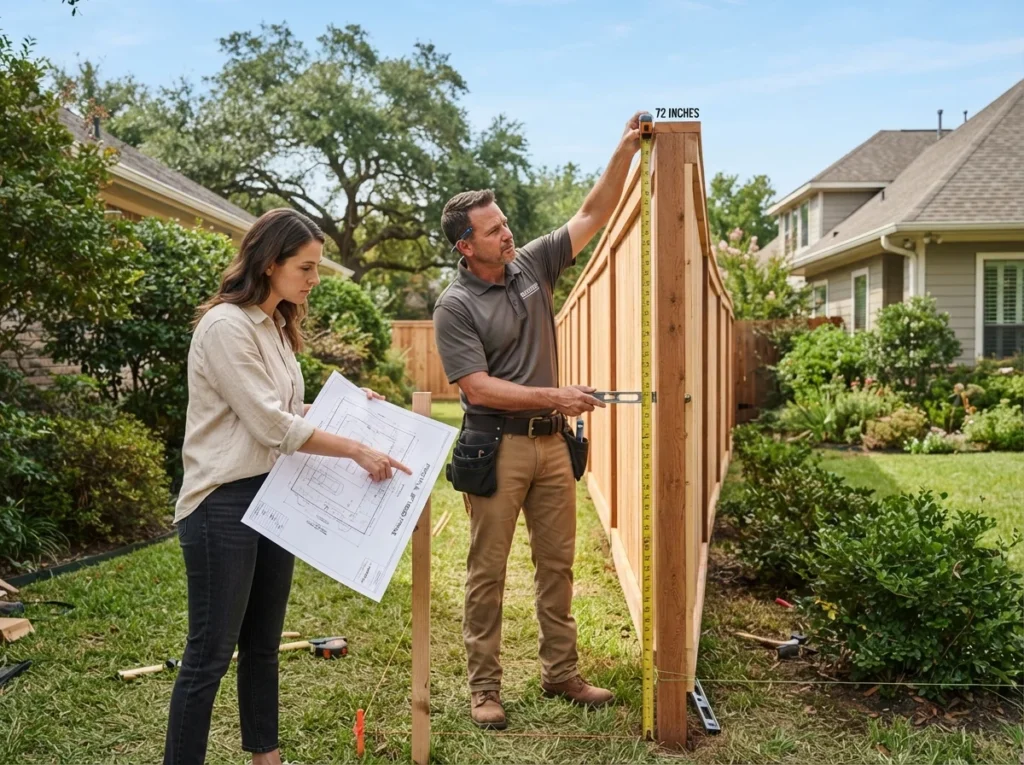
A fence that looks suitable in a catalog may not work in the exact location you have planned. Patchogue’s rules address height, street frontage, corner areas, and the relationship between a fence and the building line. Those details should be reviewed before materials are ordered.
Know the General Fence Height Limit
For the A Residence, B Residence, C Residence, and B Residence and Office Districts covered by §435-40, the general maximum is 6 feet. That does not mean every part of a residential property can have a six-foot fence. The code creates lower limits for certain locations.
Where a fence is along a road or highway, its height is measured using the existing elevation of the highway centerline opposite the fence. At a road intersection, the code limits the fence to 2.5 feet within a 15-foot radius of the corner. This is why the phrase “six-foot fence allowed in Patchogue” does not tell the whole story.
The code also limits certain chain-link fences without inserts that do not materially block visibility to 4 feet. Split-rail fences are likewise limited to 4 feet under this provision. So when reviewing the Village of Patchogue fence height restrictions, look at the location of the fence rather than considering height by itself.
Check the Fence Location, Not Just Its Height
Placement has its own requirements. If a building-lot boundary is next to a street, road, or highway, the code requires the fence to be at least 10 feet from that boundary. This restriction was added to §435-40 when the law was enacted on March 24, 2025.
That 10-foot requirement is not the same as the separate 30-inch building-line rule. Between a street-adjacent boundary and the building line of the principal structure, a fence cannot exceed 30 inches in height when measured from the road grade. The code also says that the fence cannot exceed any other applicable height limit.
Corner properties need another check. The 2.5-foot maximum applies within the specified 15-foot radius of an intersection. The 10-foot street-boundary requirement is a separate placement rule. Fence orientation matters too. Section 435-40(B) requires the finished side to face the adjoining neighbor’s property. There is a limited exception for qualifying older fences when the owner provides sufficient proof of the fence’s construction date to the Building Department.
These rules are different requirements. A contractor should not treat the 10-foot setback, 30-inch height limit, and 2.5-foot corner rule as if they were one restriction.
Find Out Whether Your Fence Project Needs a Permit
Patchogue’s current FAQ answers the basic question directly: a permit is required for fences in most cases. The Village says the purpose includes checking requirements involving fence height, location, and safety. That means the permit question should be settled before installation begins. Ask the village what application information is currently required for your project and whether an inspection or other compliance step applies.
The Building Department handles permit and zoning inquiries and lists its office at 14 Baker Street, Patchogue, with the phone number 631-475-4300. The Village publishes a Building Department fee schedule, but the current fee page does not list a specific residential fence permit fee. Do not assume that another construction fee applies to your fence. Confirm the applicable amount with the village before budgeting for the permit.
Before signing a contract, ask: Who will prepare and submit the permit application, communicate with the village, and coordinate any required inspections? The answer should be clearly stated in your agreement.
Make Sure the Fence Type Fits the Project Before Ordering Materials
Fence material should be selected with the proposed location and use in mind. Exclusive Fence Company INC offers several options, including:
- Wood
- Vinyl/PVC
- Aluminum
- Chain link
- Deer fencing
- Pool fencing
The key question is not simply which material looks right. If you are considering vinyl fencing, check whether the planned height, design, visibility, and placement work for the location.
For example, a homeowner may want a tall privacy fence but discover that a street-facing portion has a lower applicable limit. If the project involves a pool, pool fencing also needs to be considered along with the applicable height, placement, and safety requirements. The design should be checked against the applicable rules before materials are ordered.
Check HOA Fence Rules Before You Commit to the Project
Not every Patchogue property is governed by an HOA. If yours is, its requirements are separate from village zoning and permit requirements.
Review the HOA fence rules in Patchogue that homeowners may be subject to before finalizing the design. Check whether the association requires architectural approval or written permission. Look for requirements covering:
- Fence materials
- Height
- Color or finish
- Design
- Placement
- Application forms
- Review procedures
Do not assume an HOA has approved a fence simply because the village allows it. The reverse is also true. HOA approval does not replace municipal approval. If both apply, the project may need to satisfy the village requirements and the private restrictions imposed by the association.
The contractor’s role should also be clarified. Some contractors may offer assistance with approval processes, while others may leave those tasks to the property owner. The written agreement should state what is included.
Questions to Ask a Fence Contractor Before Hiring

Once you understand the basic requirements, use the estimate meeting to clarify responsibilities. You can also review these questions to ask a fence contractor before hiring to make sure important project details are covered.
Ask:
- Will you review the proposed fence location against the applicable village requirements?
- Will you handle the building permit, or is that my responsibility?
- If a permit is required, who prepares and submits the application?
- Who communicates with the village if more information is requested?
- Who coordinates any required inspection?
- How will the proposed fence location be established?
- Does the fence design I selected fit the proposed location?
- What information do you need from me before preparing the estimate?
- If an HOA applies, who is responsible for its submission?
- Are permit or approval costs included in the estimate or handled separately?
- Will the finished side face the adjoining property as required?
Do not accept a vague answer when responsibility could affect the project. If a permit, HOA submission, inspection, or other approval is part of the plan, identify who is responsible before you sign.
What to Have Ready Before Requesting a Fence Estimate
A contractor can give more useful feedback when the basic project details are ready.
Have these available if you can:
- Property address
- Approximate fence location
- Desired fence type
- Preferred height
- Gate locations
- HOA information, if applicable
- Details about an existing fence
- Existing survey or property documents, if available
- Any information already received from the village
You do not need to order a new survey simply because you are requesting an estimate. Whether one is needed depends on the project and the information available for the property. If you are also planning your budget, this fence installation cost guide can help you understand some of the costs that may affect the project.
Do Not Assume an Existing Fence Can Simply Be Replaced
An existing fence does not automatically establish that a new fence can be installed in exactly the same place or at the same height.
Current requirements may affect a replacement, especially if you are changing the fence’s height, location, material, or design. The village’s current zoning rules also include requirements that were amended in 2025, so an older fence is not proof that the same arrangement is allowed today.
If you want the replacement to follow the existing layout, verify the current requirements first. That is safer than treating the old fence as an automatic approval for the new one.
A Four-Point Check Before You Hire
Before signing a fencing agreement, make sure these four areas have been addressed:
| What to Check | What the Homeowner Should Confirm |
| Local rules | Which village zoning requirements apply to the property |
| Height, placement, and orientation | Height limits, street-related setbacks, corner rules, and which side of the fence must face the neighbor |
| Fence type | Whether the selected material and design fit the applicable rules |
| Permit and HOA | Whether a permit or HOA approval applies and who will handle each |
You do not necessarily have to manage every item yourself. The important part is knowing which questions need answers and which person is responsible for each task.
Frequently Asked Questions
Do I need a permit to install a fence in Patchogue, NY?
The village currently states that a permit is required for fences in most cases. Confirm the current requirements with the Building Department before work begins.
How high can a fence be in the Village of Patchogue?
For the districts covered by §435-40, the general maximum is 6 feet. Location can create a lower limit. Within the specified 15-foot radius of a corner formed by intersecting roads or highways, the maximum is 2.5 feet.
Are there special rules for a corner lot?
Yes. The code limits fence height to 2.5 feet within the specified 15-foot radius of an intersecting-road corner. That does not mean every part of every corner lot has a blanket 2.5-foot limit. Other placement rules may also apply.
Does HOA approval replace a fence permit?
No. They are separate requirements. If your property is subject to an HOA, you may need its approval in addition to satisfying Village requirements.
Which side of the fence should face my neighbor?
Under §435-40(B), the finished side must face the adjoining neighbor’s property, subject to the code’s limited exception for qualifying older fences.
Should the contractor handle the permit?
That depends on the contractor’s process and your agreement. Ask who prepares the application, communicates with the village, handles fees, and coordinates inspections. Put those responsibilities in writing.
Ready to Plan Your Fence in Patchogue, NY?
Before you move forward with a new fence, make sure the proposed height, location, and design fit the current village requirements. Check whether a permit applies, review any HOA restrictions, and clarify who will handle applications or other approvals. Having those details settled first can make the estimating process much clearer.
Exclusive Fence Company INC provides residential and commercial fencing services in Patchogue, NY. We offer wood, vinyl/PVC, and aluminum fencing, along with chain link and specialty fencing options.
Our team can help you discuss the fence style, material, and layout that fit your property. You can also get a clearer idea of the project scope before installation begins. If you are planning a fence project in Patchogue, contact Exclusive Fence Company INC at +1 631-946-4740 to discuss your plans and request a free fence estimate.